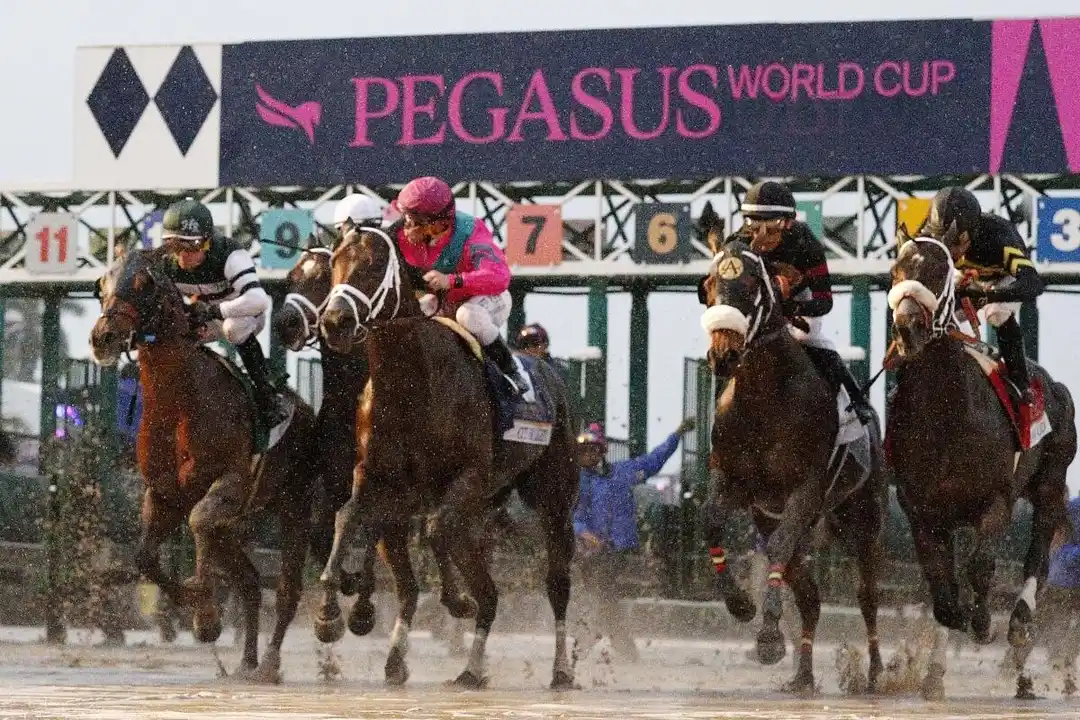
Bettors often overlook the most critical factor in championship racing: the track itself. While Grade 1 glory usually follows the horse with the highest Beyer Speed Figure, Gulfstream Park operates under a different set of rules. This Hallandale Beach oval possesses a unique "speed-favoring" dirt surface and a notoriously tight turf course that humiliates elite champions every year. To find success in your Pegasus World Cup betting strategy, you must stop looking at who is the "best" horse and start looking at who is the "best Gulfstream" horse.

Gulfstream Park’s dirt track acts as a conveyor belt for front-runners. Recent data from the 2024-2025 Championship Meet confirms a devastating reality for deep closers. Statistics show that "speed horses" (those on or within one length of the lead) win a staggering 56% of dirt sprints. This bias does not vanish when the distance stretches to the 1 1/8-mile Pegasus trip. In fact, horses coming from more than four lengths back win only 8% of one-turn dirt miles.
When checking the Pegasus World Cup Odds, you must prioritize tactical speed over a "big finish."
The track consistency at Gulfstream remains firm and fast, offering a "bouncy" sensation that rewards horses with high-knee action and immediate acceleration. If a horse relies on a long, sustained drive from the back of the pack, they will likely find themselves eating sand behind a wall of speed that never slows down. You should look for horses that can secure an inside path early, as the rail remains the "golden lane" during the winter meet.
While the dirt favors raw speed, the turf course demands surgical precision. The Gulfstream turf is a "tight-turn" configuration that forces horses into high-pressure maneuvers. European shippers or horses coming from wide-sweeping tracks like Belmont Park often struggle to negotiate these 1 1/16 and 1 3/16-mile routes. Success in Pegasus World Cup betting on the grass requires a horse that can "corner on rails."
Stalkers dominate the Gulfstream lawn, winning approximately 50% of turf routes. Unlike dirt, where you want the lead, the turf rewards horses sitting one to four lengths off the pace. These "mid-pack" runners save ground on the tight turns and pounce the moment the field enters the short homestretch. If you see a horse with a history of wide trips or "hanging" in the stretch on other tracks, expect them to fail here.
Florida’s tropical climate introduces a physiological variable that most handicappers ignore. The transition from the crisp, dry air of New York or Kentucky to the heavy humidity of Hallandale Beach creates significant stress on an equine athlete. A horse’s core temperature can rise by 1.3°F per minute during exercise. In high humidity, sweat does not evaporate efficiently, preventing the horse from cooling down. This leads to the "bounce" (a performance regression where a talented horse looks "flat" or "dull" despite having no injury).
When evaluating Pegasus World Cup Odds, you must identify the "Horse for the Course." These are individuals who have spent the winter acclimating at Palm Meadows or Gulfstream’s main stable area. These horses develop a natural tolerance for the heat-humidity index. Shippers arriving only 72 hours before the race are the most vulnerable. Look for horses with "sweat-resistant" records—those who have won in Florida, California, or the Mid-Atlantic summer.
How do you spot a Gulfstream specialist? You look for "Pace Points" and consistency in high-speed, flat-track dynamics. A true Gulfstream specialist displays a specific behavior: they "jump" out of the gate and immediately seek the rail. This is not just athleticism; it is a learned behavior. Horses that train on this surface understand that the first 100 yards determine the final result.
Review the past performances for horses that have "C&D" (Course and Distance) wins at Gulfstream. A horse like White Abarrio or Skippylongstocking thrives here because they handle the "kickback" (the sand thrown up by leading horses) and the humidity without panicking. When you analyze the Pegasus World Cup contenders, disregard recent wins at Saratoga or Churchill Downs if the horse has never handled the unique Florida "sand-and-sea" composition.
Because the first turn in the Pegasus World Cup comes up so quickly, the post position draw is a "make-or-break" event. Inside posts (1 through 5) provide a massive advantage in two-turn dirt routes. Statistically, horses drawn outside post 8 at this distance face a nearly impossible task of clearing the field before the turn. If a speed horse draws the rail, their Pegasus World Cup Odds will likely plummet, and for good reason.
You must watch the "warm-up" on the track before the race. A horse that is "washed out" (covered in white, soapy sweat) before reaching the gate is already losing the battle against the Florida humidity. This is a clear indicator of a "shipping bounce" or heat stress. Conversely, a horse that appears calm, dry, and alert in the walking ring is the one you want to back.
The betting public loves "names," but the smart money loves "neighborhoods." The neighborhood here is in South Florida. Often, the favorite in the Pegasus World Cup is a California or New York superstar whom the public bets down to 4/5. This creates incredible value for the local "warrior" who sits at 8/1 or 12/1. These local horses have the home-field advantage of the "speed-favoring" dirt and the "tight-turn" turf.
Exotic bets like the Exacta and Trifecta at Gulfstream often trigger massive payouts because a single "vulnerable favorite" fails to handle the track bias. If you identify a speed horse that can clear the field from an inside post, you have the anchor for your betting ticket. Combine that speed with a "stalker" who handles the humidity, and you have a high-probability winning combination.

In the era of advanced analytics, you cannot rely on "gut feelings." You must use speed figures adjusted for track variants. Gulfstream Park often plays "fast" in January, meaning raw times look more impressive than they actually are. Compare the "internal fractions" of a horse's previous races. If a horse can run a 23-second first quarter and a 46-second half-mile without tiring, they are built for the Pegasus World Cup.
Always keep an eye on the jockey-trainer combinations that specialize in Florida. Trainers like Todd Pletcher and Saffie Joseph Jr. understand the nuances of the Gulfstream surface better than anyone. They prepare their horses to be "deadly" from the gate. When these trainers enter a horse with tactical speed, you must include them in your Pegasus World Cup betting slips.
The Pegasus World Cup is more than just a race; it is a test of environmental adaptation. By focusing on surface bias and horse behavior, you gain an edge over 90% of the betting public. You now know that speed is king on dirt, stalking is the key on turf, and Florida humidity is the silent favorite-killer. Use this knowledge to dissect the field and find the true "Gulfstream Specialist."
The gates are about to crash open, and the sand will fly under the Florida sun. Do not let the "big names" distract you from the biological and geographical truths of Gulfstream Park. The track bias is real, the humidity is relentless, and the speed is absolute. Secure your edge today by analyzing the latest Pegasus World Cup Odds and placing your bets with a specialist's precision. Stay tuned to US Racing, join the winners’ circle, and turn these insights into a legendary payout.

The writing team at US Racing is comprised of both full-time and part-time contributors with expertise in various aspects of the Sport of Kings.