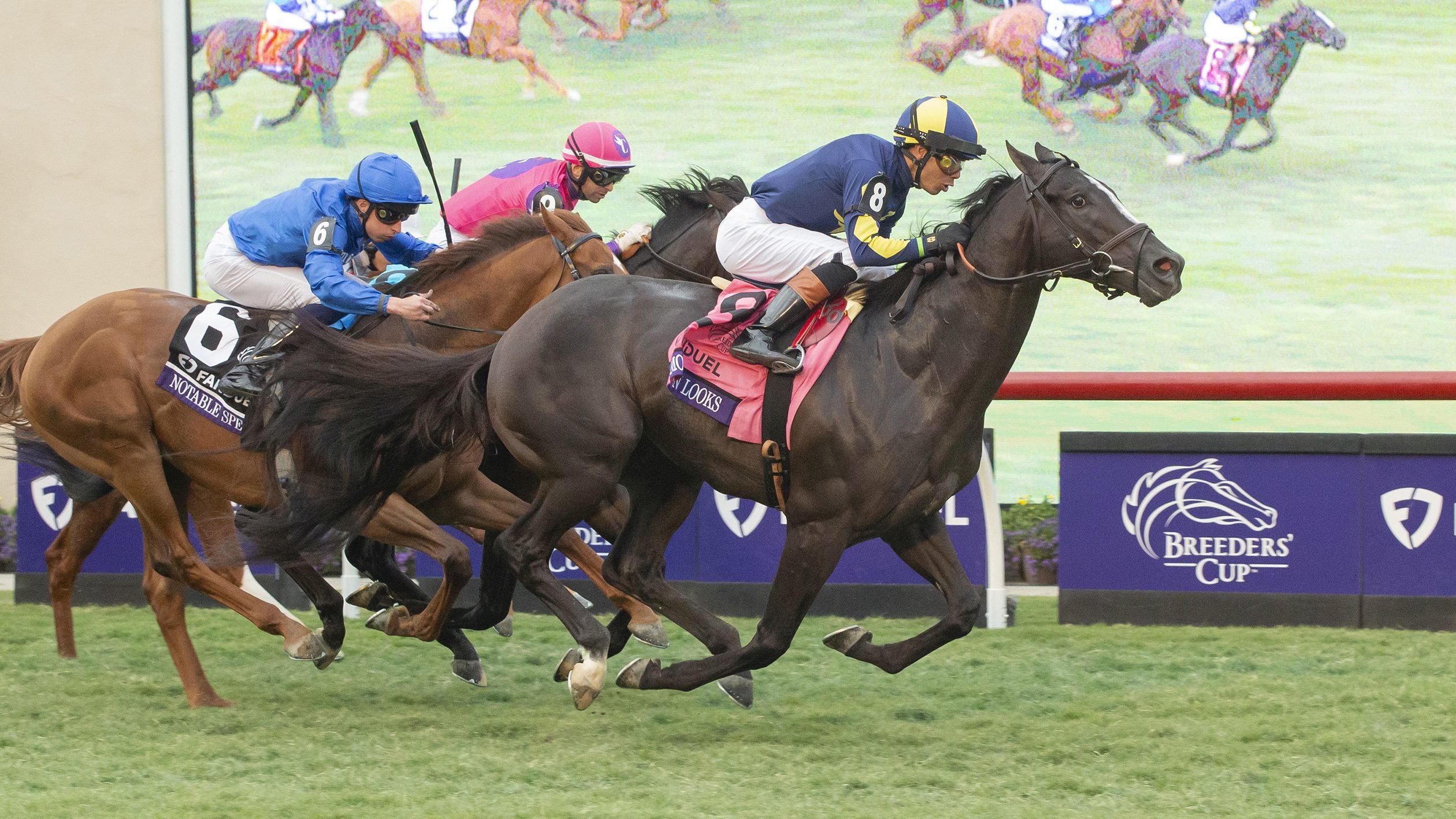
The $2 million Breeders’ Cup Mile (G1) is one of the original races when these championships began in 1984, and the mile on turf has been a bonanza for European horses running in North America.
Check the Time for the Breeders’ Cup Mile and complete the race card for the “Championship Saturday”:
| Race | Race Name | Post Time ET |
|---|---|---|
| Race 4 | Breeders' Cup Dirt Mile (G1) | 1:10 p.m. |
| Race 5 | Breeders' Cup Turf Sprint (G1) | 1:48 p.m. |
| Race 6 | Breeders' Cup Sprint (G1) | 2:26 p.m. |
| Race 7 | Breeders' Cup Filly & Mare Turf (G1) | 3:04 p.m. |
| Race 8 | Breeders' Cup Filly & Mare Sprint (G1) | 3:42 p.m. |
| Race 9 | Breeders' Cup Mile (G1) | 4:20 p.m. |
| Race 10 | Breeders' Cup Distaff (G1) | 4:58 p.m. |
| Race 11 | Breeders' Cup Turf (G1) | 5:36 p.m. |
| Race 12 | Breeders' Cup Classic (G1) | 6:16 p.m. |
Last Updated on 09/22/2026
European runners have fared exceptionally well in the Mile, starting with the inaugural winner Royal Heroine. Though she had been training in California with British conditioner John Gosden, she began her career in Europe and won several races. However, her Breeders’ Cup score was her most famous and earned her an Eclipse Award as North America’s best female turf performer.
Other European winners of the Mile include Last Tycoon (1986), Miesque (1987, 1988), Royal Academy (1990), Barathea (1994), Ridgewood Pearl (1995), Spinning World (1997), Domedriver (2002), Six Perfections (2003), Goldikova (2008, 2009, 2010), Karakontie (2014), Expert Eye (2018), Order of Australia (2020), Space Blues (2021), Modern Games (2022) and Master of the Seas (2023).
Ireland-bred and France-based Goldikova won this race three years in a row from 2008 to 2010 and remains the only three-time Breeders’ Cup winner. Four others won this race twice – Miesque (1997, 1988), Lure (1992, 1993), Da Hoss (1996, 1998) and Wise Dan (2012, 2013).
Champion French jockey Olivier Peslier, Hall of Famer John Velazquez and England-based William Buick have each ridden three winners to lead all jockeys. Peslier was aboard Goldikova in all of her starts, while Velazquez rode Da Hoss in 1998, Wise Dan in 2012 and World Approval in 2017. Buick piloted three in a row for Charlie Appleby from 2020 to 2023 – Order of Australia, Space Blues and Modern Games.
Thanks to Goldikova, jockey-turned-trainer Freddie Head, who was Miesque’s pilot for her two wins, is one of the race’s leading trainers. Charlie Appleby joined him with his third consecutive win in the race in 2023. And Flaxman Holdings (Niarchos Family) has owned six winners of this race – Miesque (1987, 1988); Spinning World (1997); Domedriver (2002); Six Perfections (2003); and Karakontie (2012). The late Stavros Niarchos himself was listed as Miesque’s owner.
Tourist owns the fastest time when he ran the mile in 1:31.71 over Santa Anita’s firm turf in 2012.
1984 – Royal Heroine set the stage at Hollywood Park, scorching the turf in a sizzling 1:32.60 to win the inaugural Mile. Her filly flair against a field of colts established the race as a global turf spectacle, igniting its legacy with a memorable performance that still stands.
1987, 1988 – Miesque shipped across the Atlantic to claim back-to-back victories, beginning what would be close to European dominance. Her razor-sharp acceleration left rivals struggling and she proved fillies could rule the Mile as the first to conquer the race twice, setting a benchmark for greatness.
1990 – Royal Academy delivered a storybook finale at Belmont Park, thundering home under 55-year-old legend Lester Piggott, who came out of retirement 12 days earlier, in his final Breeders’ Cup ride. The Irish colt’s performance, guided by Piggott’s timeless mastery, stunned the field and capped a legendary jockey’s career with an emotional and memorable victory that resonated far beyond the turf.
1992, 1993 – The Shug McGaughey-trained Lure owned the turf in the early 1990s, cruising to consecutive frontrunning wins at Gulfstream Park and Santa Anita Park. The Claiborne Farm homebred’s effortless, daylight margins showcased his dominance in the division, and he proved domestic talent could shine just as brightly as international stars.
1996, 1998 – Da Hoss scripted the end to his improbable career in 1998 at Churchill Downs, returning from a two-year injury layoff to claim his second Mile crown. The unassuming gelding’s heart-stopping charge for trainer Michael Dickinson through a stacked field was a testament to grit and redemption, a comeback that represented the soul of racing’s unpredictability.
2008, 2009, 2010 – The French-raced mare Goldikova forged an as-yet unmatched dynasty, securing an unprecedented three-peat under Olivier Peslier. Her 2009 masterpiece — slicing through traffic from dead last to first — was magic, her relentless will and versatility etching her into the Hall of Fame as the Mile’s greatest champion.
2012, 2013 – Wise Dan ruled the Mile for two years, his tenacity earning Horse of the Year honors in both years. His 2012 Santa Anita blitz shattered the course record with a 1:31.78, while his 2013 repeat overcame a wide trip to win with every ounce of his heart. His electric bursts of speed made him a fan favorite.
2016 – Tourist delivered a heart-pounding thriller at Santa Anita, unleashing a ferocious final kick to edge out Tepin in a 1:31.71 photo finish, one of the fastest Miles ever. His vengeful surge denied Tepin’s repeat bid and nearly broke the course record, cementing his legacy as a closer with nerves of steel. These victories, each a unique chapter of courage and brilliance, define the Mile’s storied history.
Betting on the Breeders’ Cup Mile highlights a mix of favorite reliability and longshot potential, with favorites winning 14 of 41 editions (34% success rate), including eight of the last 17. European horses have dominated recently, winning five of the last seven, which influences wagering toward international contenders, especially those trained by Appleby (three winners: 2021-2023).
Betting activity often favors horses with strong prep form from races like France’s Prix de la Foret (G1), Woodbine Mile (G1), or Coolmore Turf Mile (G1), as these have produced multiple winners.
Longshots have spiked interest, with upsets like Order of Australia at 73-1 in 2020 contributing to higher average payoffs and potentially larger pools due to exotic bet appeal. There is significant value in trends like runners with exactly six starts in the past year (producing 10+ winners).
Over the last 12 years, the average win payoff has been $25.63, with exacta averaging $307.19, skewed by upsets topped by Order of Australia ($148.40) Recent low payoff examples:
Females have five wins from 43 runners in the last 20 years, and 3-year-olds (mostly European) have 12 total wins, adding layers for trifecta/superfecta plays.
The Breeders' Cup Mile strongly favors off-the-pace runners, with no wire-to-wire winner since Lure in 1993 -- marking 31 straight editions without a front-runner prevailing.
Historical analysis over the last 25 years shows no winner leading after the opening quarter mile or half mile, and only two leading into the top of the stretch. Winners average 5.75 lengths back after the opening quarter mile, with 16 of 25 positioned seventh or farther early, and a median of eighth.
This setup punishes early types and pacesetters, as tactical speed is a disadvantage. Instead, stalkers, stalker/closers, and dedicated closers dominate (20 of last 21 winners profiled as such, with only one press-the-pace type in 2017).
For this year at Del Mar, expect a similar scenario: fast early fractions setting up for mid-pack explosions, with the winner having the ability to post final time of around 1:33 to 1:34.
The writing team at US Racing is comprised of both full-time and part-time contributors with expertise in various aspects of the Sport of Kings.