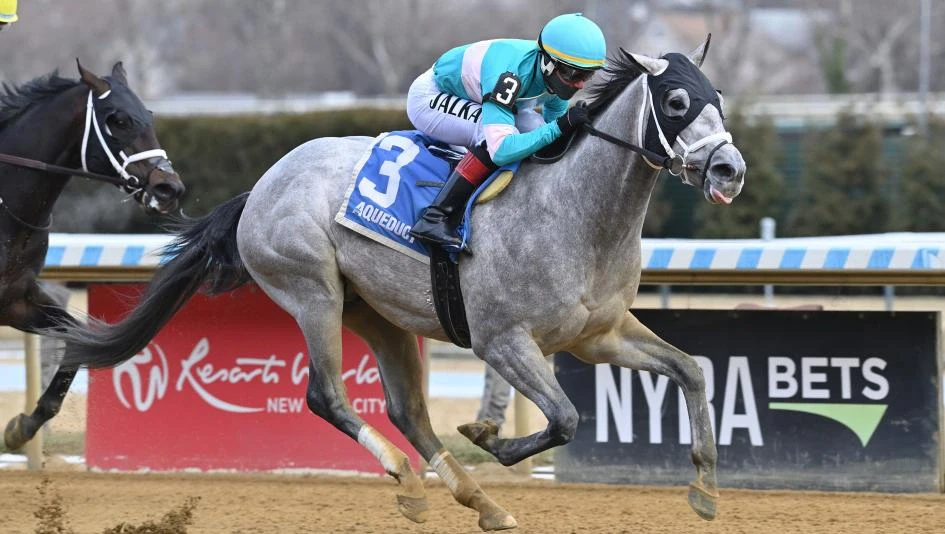
The dust has settled at Aqueduct following the Jerome Stakes on January 3, and the racing world is buzzing over My World’s dominant performance. However, seasoned handicappers know that the road to Churchill Downs rarely follows a straight line, or in this case, a single turn. While My World secured the winner’s share of points on the Kentucky Derby leaderboard, history suggests we must scrutinize one-turn mile victories with extreme caution.
The Jerome often serves as a crossroads where brilliant sprinters masquerade as classic contenders, creating a "distance trap" for unsuspecting bettors. To find true value in the Kentucky Derby contenders, you must look past the winner's circle and analyze how these three-year-olds handled the unique geography of the Big A’s main track.

One-turn miles like the Jerome test raw speed and tactical positioning more than true stamina. In these races, horses don't have to navigate the "clubhouse turn," which allows them to maintain a high cruising speed without the physiological cost of downshifting and accelerating twice.
When you check the latest Kentucky Derby Odds, you often see Jerome winners sitting at shorter prices than their pedigrees justify. This creates a market inefficiency. You must decide if My World won because he is a superior athlete or because the race structure played directly into his sprint-leaning tendencies. If he cannot replicate this effort over two turns, his current price represents a poor investment for those looking to bet on Kentucky Derby futures.
Betting on the Derby requires you to act as a geneticist as much as a clocker. The "Angle" here focuses on the disparity between a horse's performance at eight furlongs versus their potential at ten furlongs. While My World flashed brilliance, his pedigree suggests a ceiling. If a horse possesses a high "dosage index" or a sire line rooted in Metropolitan Mile winners rather than Belmont Stakes champions, the Jerome might be their peak.
Wise gamblers prioritize "Derby Horses" that look uncomfortable at a mile but finish with energy. You should hunt for the grinders who began their best work in the final sixteenth of a mile, as these individuals typically thrive when the Kentucky Derby prep races transition to 1 1/8 miles and beyond in the coming months.
Analysis of the tracking data from the Jerome reveals a fascinating story regarding Balboa, who finished a deceptively strong second. While My World took the trophies, Balboa displayed a massive stride length of $24.1$ feet during the final quarter-mile. For context, the average Thoroughbred stride measures roughly 20 to 22 feet. A stride length exceeding 24 feet indicates a massive mechanical reach, a trait often shared by champions who need more ground to find their rhythm.
Balboa’s inability to catch My World in a one-turn mile shouldn't discourage you. Instead, it should signal that he is a "galloper" who will appreciate the two turns of the Wood Memorial Stakes or the Blue Grass Stakes. His efficiency of movement suggests he will save more energy than his rivals when the distances increase.
Professional gamblers often utilize a strategy called "bet the lose, not the win." This involves identifying a horse that lost a race for reasons that will vanish in their next start. In the Jerome, Balboa got "out-sprinted" rather than "out-stayed." His lung capacity and recovery rate post-race (monitored by trainers and sharp clockers) indicate a horse that barely broke a sweat despite the high-speed chase.
When you look at Kentucky Derby betting, you want to find the horse that showed "plus-gallop out" stats. Did the horse pass the winner after the finish line? Balboa did exactly that, cruising past My World around the first turn after the wire. This visual cue tells you that the horse has the cardiovascular engine to handle the grueling 1 1/4 miles in May.
We cannot dismiss My World entirely, but we must contextualize his victory. He utilized a "lone lead" on a track that historically favors speed. When a horse wins the Jerome in a gate-to-wire fashion, they often face a rude awakening in the Kentucky Derby prep races like the Fountain of Youth Stakes or the Florida Derby. In those races, they encounter "honest pace" pressure from other elite speedsters.
If My World’s internal fractions (the time it takes to run each quarter-mile) show a significant slowdown in the final furlong, he is a "miler." A true classic contender maintains or increases their velocity at the end of the race. Currently, My World’s slowing late splits suggest he may struggle when he has to navigate two turns against higher-quality Kentucky Derby contenders.
The transition from one turn to two turns represents the most difficult hurdle for a three-year-old. It requires "tactical speed" (the ability to relax behind leaders and then accelerate when the jockey gives the signal). Horses that look "trapped" or "uncomfortable" in the kick-back of a one-turn mile often explode when they get the clear running room of a wider, two-turn configuration. You should monitor the Kentucky Derby futures for horses that finished 3rd or 4th in the Jerome while racing wide. These horses covered more actual distance than the winner. By calculating the "ground loss" data, you might find that Balboa actually ran a faster race than My World when adjusted for the path he took around the turn.
The winter meet at Aqueduct often features a "heavy" or "tiring" surface that can skew results. A one-turn mile on a muddy January afternoon is a world away from the fast, hard dirt of Churchill Downs in May. If the Jerome took place on a "speed-biased" track, the result would be virtually meaningless for the Derby. However, if Balboa managed to close ground against the bias, his performance would become elite.
Savvy players check the daily racing form for "track variants" to see if the inner dirt was playing fast or slow. This data allows you to refine your Kentucky Derby betting strategy by identifying which horses overcame the environment and which ones were simply "carried" by the track.

The Kentucky Derby futures pools offer a chance to lock in massive prices before the public catches on to the "hidden" performers. If you wait until Balboa wins a major 100-point prep race, his odds will plummet from 50-1 to 8-1. By applying the "stride length" and "two-turn" logic now, you can secure value. The Jerome provides the perfect smokescreen.
The public bets the winner (My World), while the experts bet the "project" (Balboa). You should distribute your bankroll across 3 or 4 Kentucky Derby contenders who fit the physical profile of a stayer. Look for high-slung shoulders, deep chests for lung capacity, and that crucial 24-foot stride.
The Jerome Stakes serves its purpose as a developmental stepping stone, but it rarely produces the Kentucky Derby winner directly. Instead, it produces the "wise guy" horses that fill out the exacta. My World is a talented colt, but his future likely lies in the Pat Day Mile on the Derby undercard rather than the Run for the Roses itself. Balboa, conversely, possesses the physical tools to thrive under the Twin Spires. As you analyze the Kentucky Derby Odds, remember that a mile is a sprint for a classic horse. You are looking for the marathoner who was just getting started when the wire arrived. Trust the physics of the stride and the logic of the pedigree over the flash of a January trophy.
Don't let the best prices gallop away while you sit on the sidelines. The road to Churchill Downs is paved with opportunities for those who know how to read between the lines of the Jerome Stakes. Whether you are backing a proven winner or hunting for a long-shot "stayer" like Balboa, now is the time to act.
Stay tuned to US Racing to access our premium handicapping tools and get the best Kentucky Derby betting action available.
Take advantage of our exclusive 100% deposit match and start building your Derby bankroll right now. The finish line is closer than you think; make sure you're holding the winning ticket.

The writing team at US Racing is comprised of both full-time and part-time contributors with expertise in various aspects of the Sport of Kings.