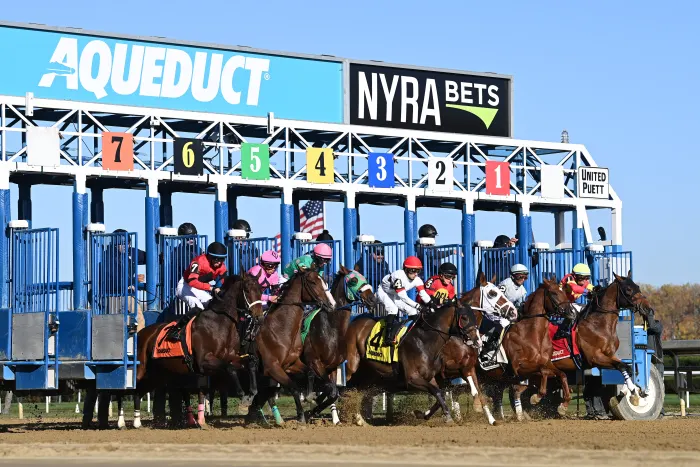
Nothing lasts in this world, especially an old racetrack that’s been allowed to fall apart for 25 years. Aqueduct holds so many memories for New York racing fans, but by next September, it won’t be making any more.
The decrepit Big A’s days are numbered. A track founded in 1894 will close for good when the ultramodern iteration of Belmont Park opens. On Saturday, the $250,000 Remsen Stakes (G2), which dates from 1904, will be run for the final time at the track in Queens.
Most handicappers know the Remsen as a 1 1/8-mile race that sometimes launches 2-year-olds with the potential to excel in the Triple Crown. In 2021, Mo Donegal won it six months before taking the Belmont Stakes (G1). Two years later, future Belmont hero Dornoch nosed out Sierra Leone, who lost by that margin in the Kentucky Derby (G1) before scoring in the 2024 Breeders’ Cup Classic (G1) that autumn.
Quick Tip: Before you check the upcoming information, boost your bankroll with the top new-player bonus.

What almost nobody knows is why it’s called the Remsen. It’s named for Jeromus Remsen (1735-1790), a descendant of German immigrants who in the 17th century established a farm in what is now Queens. As a young man, Jeromus fought on the side of the British in the French and Indian War (1754-63).
According to Queens Name Explorer, “Following his service, Remsen became part of the minority in Queens who opposed the King after the colonies declared independence.” By the mid-1770s, he was an officer in the Continental Army.
In late August of 1776, early in the Revolutionary War, Colonel Jeromus Remsen was among the patriots’ leaders at the Battle of Long Island, also known as the Battle of Brooklyn and the Battle of Brooklyn Heights. The first major engagement since the recent signing of the Declaration of Independence did not go well for the rebels.
The Brits, who outnumbered the Americans, roughly 20,000 to 10,000, captured New York City and Long Island and inflicted more than 2,000 casualties. As for Remsen, he managed to survive, although many of his men in the Seventh New York Regiment did not. According to the Queens Name Explorer, “they joined the brigade of General Greene in Brooklyn and were routed at the Battle of Long Island.”
The patriot army lived to fight another day, thanks to an evacuation ordered by General George Washington. “After the retreat, Remsen fled to New Jersey for safety, where he remained until after the war.”
Remsen had the courage to risk it all and take on the most powerful empire in the world, which deserves admiration. He was a major player in a demoralizing defeat, but his heart was in the right place. His role in the Battle of Long Island makes me think of lines in a Steely Dan song:
“They’ve got a name for the winners in the world,
I want a name when I lose.
They call Alabama the Crimson Tide,
Call me Deacon Blues.”
Remsen’s name will be remembered for as long as they run his race, which is a triumph over oblivion, even though most people have no idea who he was. You can visit him at the family cemetery in Queens, along with his cousins Abraham, Luke, and Aurt Remsen, also Revolutionary War officers.

Besides the Remsen, the Demoiselle Stakes (G2) for 2-year-old fillies, first run in 1954, and the Cigar Mile (G2), begun in 1988, will be run at Aqueduct for the last time on Saturday. Their distinguished histories will continue at the new, glitzy Belmont Park.
Time and tradition march on.

Ed McNamara is an award-winning racing writer who has covered the sport since 1981 for The Bergen (N.J.) Record, Newsday, ESPN, Thorocap, and USRacing. He is the author of Cajun Racing: From the Bush Tracks to the Triple Crown and Racing Around the World, and a contributor to The Most Glorious Crown and The Racetracks of America. He has also written for racing publications in France and Italy.