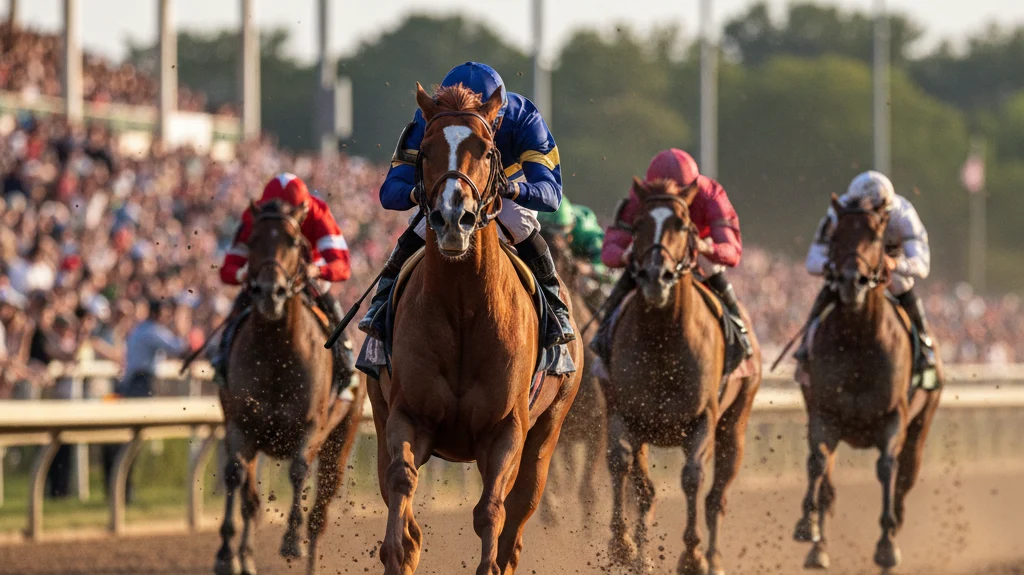
The Road to the Kentucky Derby is a grueling, five-month examination, not just of a horse's raw talent, but of its adaptability and conditioning. As analysts, journalists, and serious bettors, we often fixate on the final margin of victory, the Beyer Speed Figure, or the pedigree. However, we consistently overlook the single most predictive factor in determining whether an early prep win is legitimate or a mirage: the race shape.
The pace, dictated by the horses themselves, creates a dynamic environment that either flatters a speed-favoring horse or tests the stamina required for the first Saturday in May. Let’s dissect how the internal mechanics of pace, the fractions, the traffic, and the speed duels deliver crucial, often misleading, results in the critical qualifying races. Understanding this pace breakdown provides a significant advantage when analyzing Kentucky Derby prep races and setting your strategy for the Triple Crown season.

Pace extends far beyond the recorded time of the first quarter-mile. A true handicapper must distinguish between raw fractions and the encompassing race shape. Raw fractions, like a brisk 23-second opening quarter, tell you the speed, but the race shape, the spatial and energy distribution, reveal the exertion level.
Consider the difference between the Risen Star Stakes at Fair Grounds and the typically less taxing Tampa Bay Derby. In a Risen Star running over a deep, demanding track, a 47-second half-mile fraction often feels significantly faster than a 47-second half-mile at Tampa Bay. This is a critical distinction for anyone serious about bet on Kentucky Derby.
For instance, Horse A wins the Sam F. Davis in a moderate 1:43.00 for 1 1/16 miles, setting comfortable fractions of 24.5, 48.0, and 1:12.5, running unopposed on the lead. His final quarter-mile time might look great, a snappy 28.5 seconds, but he achieved it without pressure. Meanwhile, Horse B finishes third in the Fountain of Youth, completing 1 1/16 miles in 1:42.50, but he participated in a speed duel, contesting blistering fractions of 22.5, 45.8, and 1:10.5 before tiring late. While Horse A won, Horse B demonstrated superior fitness, surviving a pace that utterly destroyed the remainder of the field. A deep dive into the race charts shows Horse B is the legitimate Kentucky Derby contender, while Horse A is an inflated speed figure waiting to be exposed.
The calendar dictates the nature of the early prep season, heavily favoring horses with early, sustained speed. Races contested over 1 1/16 miles in January and February, such as the Lecomte Stakes or the Holy Bull Stakes, serve as foundational tests. Still, they rarely replicate the demanding 1 1/4 mile distance of the Kentucky Derby. Younger three-year-olds often lack the stamina foundation, allowing front-running horses to steal uncontested leads, thereby securing an advantage that proves unsustainable later. Track condition frequently exacerbates this bias; if the surface is speed-favoring, speed horses receive an additional, non-transferable edge.
A dominant speed horse, let's call him "Rocket Boy," might lead wire-to-wire in an 8-horse field with fractions of 23.8, 47.6, and 1:11.2, winning by five lengths. The visual result is dazzling, placing Rocket Boy high on the Kentucky Derby leaderboard. However, a meticulous analysis reveals that the field allowed him a 3-length lead through the half-mile mark with minimal pressure. This soft pace will enable him to conserve energy and finish powerfully, producing a flattering speed figure. When he faces a deep, experienced field in the final preps, the Wood Memorial or the Santa Anita Derby, where three other rivals challenge him through a 22.5 opening quarter, Rocket Boy inevitably folds. We must treat these unchallenged victories with skepticism, recognizing the pace's role in their inflated success.
As the calendar turns to March and April, the prep distances stretch to 1 1/8 miles, forcing trainers to increase their conditioning significantly. The dynamics of pace shift dramatically in the final major qualifying races, specifically the Blue Grass Stakes, Florida Derby, and Arkansas Derby. These races historically feature larger fields and, critically, multiple horses determined to control the pace, often leading to a phenomenon known as the "pace collapse." This genuine testing of stamina separates the true distance runners from the pretenders.
When multiple runners engage in a scorching speed battle—say, 22.3, 45.0, and 1:09.5—the exertion bankrupts their energy reserves. The race transforms into a contest of survival, where the horses running 6th, 7th, and 8th, wisely conserved 10-15 lengths behind the suicidal pace, now commence their rally. These closers, previously dismissed as plodders, sweep past the tiring leaders. The horse that wins this type of race, especially if he comes from 10+ lengths back and still manages to run his final 3/8 mile in under 38 seconds, proves his mettle. That horse demonstrates the stamina and sustained run necessary to thrive in the inevitable hot pace of the Derby. Savvy bettors recognize this type of gutsy, late-closing performance as the hallmark of a genuine Kentucky Derby contender, regardless of the horse's previous form.
Successful Kentucky Derby betting requires more than passively reading the results; it demands active critical analysis of the race video and chart. Bettors must learn to spot the horses whose visual performance vastly overshadows or understates their actual ability, primarily driven by the pace. The key is establishing a baseline: what constitutes a legitimately fast pace for that track, distance, and condition? When a horse wins easily on a soft, speed-favoring track, getting away with a 48-second half-mile, the market overvalues that win. His subsequent Kentucky Derby Odds will be far too short, presenting a perfect opportunity to bet against him.
Conversely, search for the horses who finished 3rd or 4th after encountering a terrible trip due to a hot pace. Imagine a horse running three-wide on the turns, chasing fractions of 22.8 and 46.2, and still managing to hang on for a minor share. That horse performed significantly better than his finishing position suggests, demonstrating heart and resilience against impossible odds. This "hidden race" is where smart money finds value. You look for the horse that ran the fastest overall race, considering the pace it ran over and the ground it covered, not just the one that crossed the line first. The market often discounts these beaten horses, providing generous value in the Kentucky Derby betting pool.
Quick Tip: Before you check the upcoming information, boost your bankroll with the top new-player bonus.

The most significant profits come from identifying value early, long before the gates open in Louisville. Analyzing the pace profiles of prep-race fields is the most direct way to determine this value in the Kentucky Derby futures market. When reviewing the field for a $1$ million final prep race, assess not only who wins, but the pace dynamic that the horse is likely to face. If a field contains four dedicated speed runners, you can confidently anticipate a pace duel. You therefore discount the front-runners and elevate the stock of the deep closers.
This strategy requires looking past the winner's circle photo. If a horse wins the Louisiana Derby in wire-to-wire fashion, but the opening half was slow (48.2) and the final time was merely average, you must mentally downgrade that performance. Do not allow him to dominate your view of the Kentucky Derby Odds. Instead, search for the beaten favorite in the same race, the one who was forced six-wide on the turn after a legitimate 46.5 half-mile and tired but still finished within four lengths of the winner. That horse demonstrated a greater ability to handle adversity and higher exertion, translating directly to a better chance on Derby Day. Future bettors who master this nuance consistently find better value than those relying solely on the win-loss record.
The progression of the prep races, from the six-furlong sprints of their juvenile year to the final 1 1/8 mile trials, is a staged test of pace handling. Early on, horses dominate through raw speed; by the end, only those with the ability to manage their energy efficiently over grueling distances survive the crucible. The horse who earns his spot on the Kentucky Derby leaderboard with a hard-fought, pace-compromised victory late in the season possesses the strongest credentials. He proves he can survive the inevitable chaos, traffic, and high-pressure fractions of the Run for the Roses.
Ultimately, we must remember that the Kentucky Derby is a race of pace, traffic, and stamina. A horse capable of sitting just off a hot 46-second pace, conserving energy, and then unleashing a sustained run over the final quarter-mile presents the ideal profile. This ability to run fast without overrunning himself is what distinguishes the Champion from the also-ran. Scrutinize the pace; it is the blueprint for the race and the key to unlocking true value.
You now possess the specialist's toolkit, moving beyond surface-level results to analyze the engine room of the race: the pace. Knowing the difference between an artificially slow pace and a legitimately contested speed battle gives you a crucial analytical edge over the casual fan setting their Kentucky Derby betting slip.
Don't let valuable qualifying points cloud your judgment; instead, use the pace data to grade a horse's performance honestly. The final Derby field will feature a hot pace, that much is guaranteed. Identifying which horse can overcome the pace profile of the early preps and thrive on the first Saturday in May is the ultimate handicapping challenge.
The insights are here, the Kentucky Derby Odds are waiting, and the time to act is now. Stay tuned to US Racing for our premium analysis service today to get our detailed pace projections and exclusive Kentucky Derby futures picks, turning your pace knowledge into Triple Crown profits.
The writing team at US Racing is comprised of both full-time and part-time contributors with expertise in various aspects of the Sport of Kings.