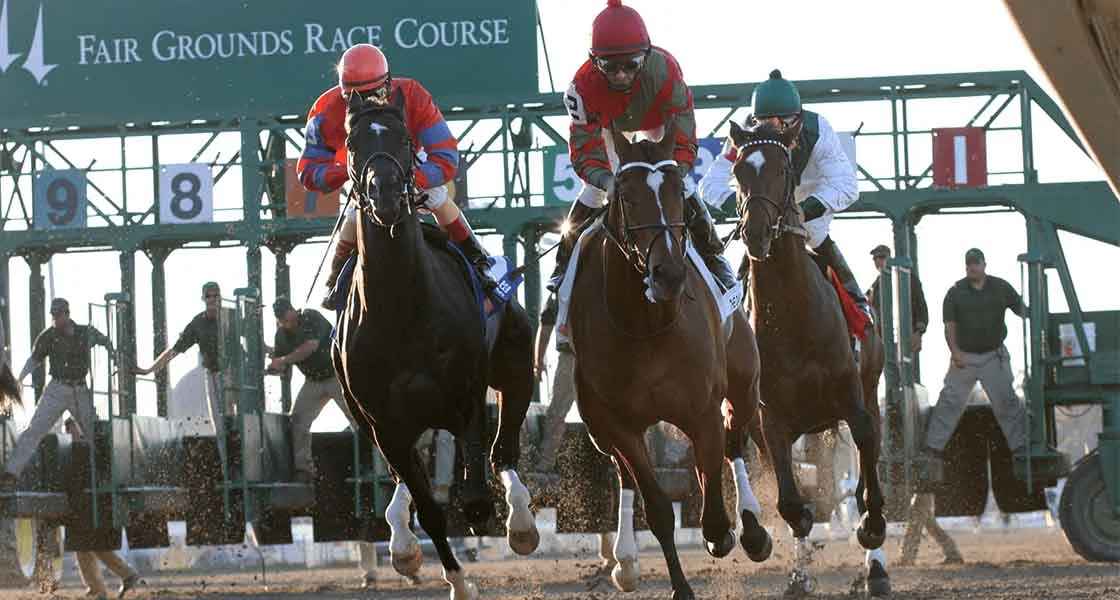
As the countdown to the next round of Kentucky Derby Prep races continues and the Lecomte Stakes sits just days away, bettors searching for an edge are once again turning their eyes south. Not to Florida. Not to California. To New Orleans.
Over the past decade, the Fair Grounds Race Course has quietly become the most reliable proving ground for legitimate Kentucky Derby contenders. While other circuits produce speed, buzz, and short-priced disappointments, the Fair Grounds consistently produces horses with the stamina, mental toughness, and running style that wins on the first Saturday in May. For serious Kentucky Derby betting, that distinction matters.

The Fair Grounds prep series, anchored by the Lecomte Stakes, the Risen Star Stakes, and the Louisiana Derby, is unique in American racing. These races are longer, more demanding, and contested over a deeper surface than most early-season alternatives. Unlike one-turn sprints or speed-favoring ovals, Fair Grounds races reward horses that can relax early, finish strongly, and handle adversity.
That profile aligns almost perfectly with what it takes to win the Kentucky Derby. Churchill Downs features one of the longest stretch runs in North America, and Derby winners rarely succeed by blasting to the lead and hoping for the best. They win by sustaining momentum late. Horses that thrive at Fair Grounds already display that behavior.
Recent history makes the case clearer than any theory. Horses like Epicenter and Gun Runner used the Fair Grounds path not just as a stepping stone, but as a foundation for elite-level success. These were not flash-in-the-pan juveniles. They were developing three-year-olds who improved steadily across multiple starts, building fitness and confidence with each race.
That gradual progression is a hallmark of the Fair Grounds circuit. Trainers are not chasing early-season headlines. They are building horses for distance, durability, and peak performance later in the spring.
The Fair Grounds advantage is not accidental. It is driven by trainers who understand long-term development better than anyone in the game.
Brad Cox has turned the New Orleans winter meet into a launchpad for classic contenders. His approach emphasizes patient conditioning, spacing races properly, and letting horses mature naturally rather than forcing early brilliance. The results speak for themselves, both at Fair Grounds and beyond.
Kenny McPeek follows a similar philosophy. His runners often show incremental improvement with each start, peaking later than rivals from flashier circuits. Bettors who track these patterns gain a valuable edge when Kentucky Derby odds begin to solidify.
When elite trainers consistently choose the same circuit, it is not tradition. It is strategy.
One of the most overlooked advantages of Fair Grounds horses is their typical running style. Many winners and top finishers there are closers or stalkers, not pure speed types. The track configuration, combined with longer race distances, naturally favors horses that can settle early and finish with authority.
That trait translates directly to success at Churchill Downs. Derby fields are crowded, chaotic, and fast early. Horses that rely on early speed often fade badly in the stretch. Horses trained to close into a strong pace thrive.
If a horse can pass rivals late at Fair Grounds, it demonstrates stamina behavior that is critical for Derby success. For bettors analyzing 2026 Kentucky Derby futures, that is a signal worth respecting.
Not all prep paths are created equal. California racing often emphasizes speed and shorter races. Florida produces talented horses, but many peak too early or fail to handle longer distances under pressure. New York preps tend to lag in depth.
Fair Grounds sits in the middle, offering consistent competition without forcing horses to show everything too soon. It is a circuit designed for development, not early dominance. That makes its graduates especially dangerous when they arrive in Louisville under the radar.

For bettors, the takeaway is simple. Horses exiting the Fair Grounds path often offer better value than their resumes suggest. They may lack flashy Beyer numbers or undefeated records, but they possess traits that matter far more on Derby day.
When reviewing Kentucky Derby betting markets, look closely at horses with strong Fair Grounds form. Pay attention to how they finish, not just where they place. A fast-closing third can be more meaningful than a wire-to-wire win elsewhere.
As the Lecomte Stakes approaches, the smart money is already watching New Orleans. History suggests it should.

The writing team at US Racing is comprised of both full-time and part-time contributors with expertise in various aspects of the Sport of Kings.