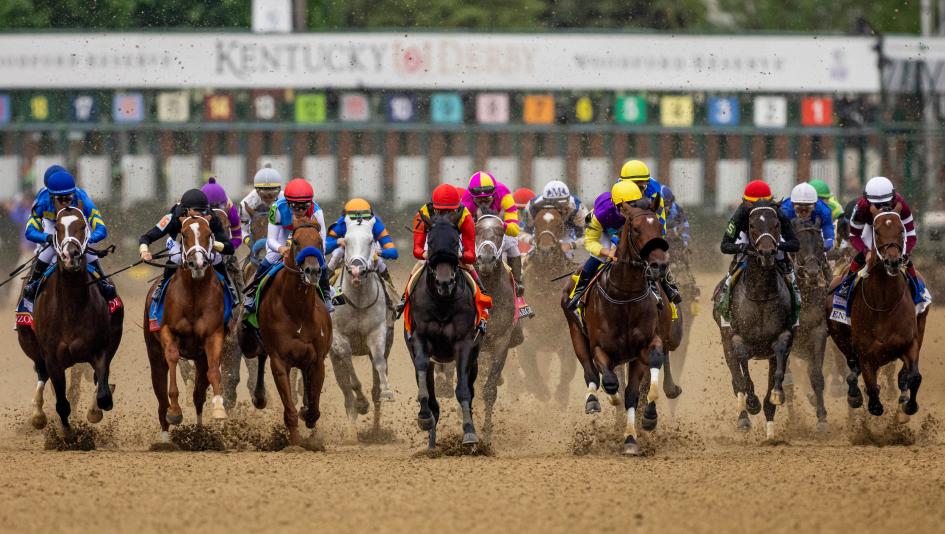
The Kentucky Derby is a different animal. Twenty horses, 1.25 miles, a field that spans multiple pace scenarios, and betting pools that swell past $200 million by post time. If you walk up to the window without a plan, Churchill Downs will take your money quickly and politely. This guide covers everything you need to operate like a sharp on the first Saturday in May, from understanding the pari-mutuel structure to building a trifecta wheel on a budget.
The Kentucky Derby runs on pari-mutuel wagering. Every dollar you put into the win pool goes in with every other dollar in that pool. The track takes its cut, which typically runs between 15 and 20 percent depending on the bet type, and whatever is left gets split among the winning tickets. There is no house line. The odds you see flickering on the tote board in the final minutes before post are a direct reflection of public money.
That structure matters because it creates overlays. When the crowd hammers a horse down to 5-2 that should realistically be 5-1 based on his form, you are subsidizing someone else's bad ticket. Conversely, when a horse sits at 15-1 on the morning line and the public ignores him because he drew an outside post, that is your opportunity. The pool is the market. Learn to read it.

Here is a clean breakdown of every wager you can make on the 152nd Run for the Roses. Check out the full Kentucky Derby betting guide at US Racing for additional detail on each bet type.
| Bet Type | What You Need | Min Bet | Best For |
|---|---|---|---|
| Win | Horse finishes first | $2 | Overlays and single-horse conviction plays |
| Place | Horse finishes 1st or 2nd | $2 | Horses you trust but want a safety net |
| Show | Horse finishes 1st, 2nd, or 3rd | $2 | Longshot closers with pace trip risks |
| Exacta | 1st and 2nd in exact order | $1 | When you have a strong 1-2 opinion |
| Trifecta | 1st, 2nd, and 3rd in exact order | $0.50 | Core exotic for most Derby bettors |
| Superfecta | 1st through 4th in exact order | $0.10 | High-variance, big-payout lottery play |
| Daily Double | Win two consecutive races | $1 | Linking the Derby with the race before or after |
| Pick 3 | Win three consecutive races | $0.50 | Building sequences around the Derby |
| Pick 4 | Win four consecutive races | $0.50 | Consolidating with confidence legs |
| Pick 5 | Win five consecutive races | $0.50 | Carryover pools and big-day sequences |
| Pick 6 | Win six consecutive races | $0.20 | Jackpot play, needs deep coverage |
If you are newer to placing these wagers, how to bet on horses at US Racing walks you through the process step by step.
The morning line is the track handicapper's best estimate of where the tote board will settle by post time. It is not a prediction of who wins. Here is how sharp bettors use it: if the morning line has a horse at 8-1 and he opens at 12-1 on the board, that is a potential overlay. If the chalk is listed at 5-2 and the crowd beats him down to 3-2, he is now significantly overbet and you are paying a premium.
The morning line gives you a reference point. The tote board tells you what the market actually thinks. The gap between those two numbers is where your edge lives.
Speed figures: Look at Beyer or Equibase figures from the preps. A horse who ran a 105 Beyer in the Arkansas Derby or Blue Grass is operating at a different class level than one who topped out at 94 in a secondary prep.
Distance suitability: A mile and a quarter separates true distance horses from speed figures earned in shorter preps. Look for horses whose pedigree and running style suggest they get better as the trip extends.
Post position: At Churchill with a full field, inside posts have historically outperformed because horses save ground on the first turn. Posts 14 through 20 require a jockey to either send hard early or sacrifice ground racing wide.
Trainer and jockey: Todd Pletcher, Brad Cox, Bill Mott, and Bob Baffert know Churchill Downs as well as any barn in America. A live horse with the right connections in the irons deserves more credit than the public typically gives.
Class trajectory: A horse improving through his conditions and hitting the Derby on an upward form cycle is more dangerous than one who peaked three preps ago. Look for the horse who ran his best race last out.
Hot pace, multiple speed horses: If three or four confirmed front-runners draw inside posts and go at each other through a fast opening half, the race sets up for a stalker or a mid-pack closer with a strong turn of foot. Horses who can sit two to three lengths off the pace and pounce at the three-sixteenths pole win Derby after Derby when the fractions are honest.
Slow pace, lone front-runner: If a single speed horse gets to the lead uncontested and controls the fractions, do not assume the closers will get there. Churchill Downs rewards front-runners who get easy fractions. A horse at 20-1 with natural gate speed becomes a serious contender in this scenario.
Moderate pace: The most common Derby scenario. Fields typically run a moderate pace because jockeys in a 20-horse field are cautious early. In this case the horse with the best raw ability usually wins.
In the 2026 field, early speed comes from Six Speed (PP 17, 50/1), Pavlovian (PP 16, 30/1), and Litmus Test (PP 4, 30/1). That sets up well for stalkers like Emerging Market, Chief Wallabee, and Further Ado.
Here is how the 2026 field breaks down. Use this structure to build your exacta, trifecta, and superfecta tickets.
These horses carry the best form and the right connections for the 1.25-mile distance. Key them on top of your trifecta and exacta tickets. Watch the tote board — if any of these come in well below morning line they are likely being pounded by sharp money.
Note on Renegade: The morning line favorite drew the worst post in the field. Post 1 in a 20-horse field is not an automatic toss but it is a legitimate concern. Todd Pletcher knows it. Factor the post into your pricing.
These horses have shown the ability but carry a question. They are where your trifecta and superfecta wheels get interesting. Pricing a 15-1 horse into the second or third slot of your trifecta costs very little and can pay dramatically.
Note on Potente: Bob Baffert horses at Churchill Downs get bet regardless of form. At 20-1 you are getting a live price on a trainer who owns this track. Worth a place in your exotics.
The 30-1 and longer shots who need a perfect pace setup and a clean trip. Do not leave them off your $0.10 superfecta entirely. In a 20-horse field, one of these lands on the board every few years and the payouts are enormous.
Check the latest odds before you finalize your tickets. The tote board moves fast in the final hour before the 6:57 p.m. ET post time.
| 2026 Kentucky Derby Odds and Post Positions | ||
| PP | Horse / Jockey / Trainer | Fractional |
|---|---|---|
| 1 | RenegadeI. Ortiz Jr. · T. Pletcher | 4/1 |
| 2 | AlbusM. Franco · R. Mott | 30/1 |
| 3 | IntrepidoH. Berrios · J. Mullins | 50/1 |
| 4 | Litmus TestM. García · B. Baffert | 30/1 |
| 6 | CommandmentL. Saez · B. Cox | 6/1 |
| 7 | Danon BourbonA. Nishimura · M. Ikezoe | 20/1 |
| 8 | So HappyM. Smith · M. Glatt | 15/1 |
| 10 | Wonder DeanR. Sakai · D. Takayanagi | 30/1 |
| 11 | IncrediboltJ. Torres · R. Mott | 20/1 |
| 12 | Chief WallabeeJ. Alvarado · B. Mott | 8/1 |
| 14 | PotenteJ. Hernández · B. Baffert | 20/1 |
| 15 | Emerging MarketF. Prat · C. Brown | 15/1 |
| 16 | PavlovianE. Maldonado · D. O'Neill | 30/1 |
| 17 | Six SpeedB. Hernández Jr. · B. Seemar | 50/1 |
| 18 | Further AdoJ. Velazquez · B. Cox | 6/1 |
| 19 | Golden TempoJ. Ortiz · C. DeVaux | 30/1 |
| 21 | Great WhiteA. Achard · J. Ennis | 50/1 |
| 22 | OcelliJ. Ramos · W. Beckman | 50/1 |
| 23 | RobustaE. Jaramillo · D. F. O'Neill | 50/1 |
Last Updated on 05/02/2026
Trifecta Part-Wheel: Key your top two horses on top and spread underneath. Example using the 2026 field: Chief Wallabee and Further Ado on top, Emerging Market, Commandment, So Happy, and Potente in second and third. At $0.50 base, this structure is manageable and gives you real coverage.
Superfecta Structure: Key one horse on top, two in second, spread three to four in third and fourth. At $0.10 base, a Chief Wallabee / Further Ado, Commandment / Emerging Market, So Happy, Potente / Danon Bourbon, Incredibolt structure is affordable and targets a realistic payout range of $2,000 to $15,000 when a mid-range longshot fills the board.
Pick 3 Around the Derby: Use singles in the races where you have conviction and spread three to four horses in the Derby leg. This keeps your ticket cost manageable while maximizing coverage in the most unpredictable leg of the sequence.
Here is a disciplined breakdown of how to deploy $100 on Derby day without blowing your roll before the gate opens.
Total: $100. Win action, trifecta coverage, superfecta upside, and a multi-race sequence. Multiple ways to cash out without overextending.
The broader conversation heading into post time centers on two things: whether Renegade can overcome post 1 at 4-1, and whether the pace scenario sets up for a mid-pack closer. The sharper voices are advocating for structured trifecta wheels around Chief Wallabee and Further Ado rather than boxing the top four and hoping for the best.

The Derby uses pari-mutuel wagering. All bets of the same type go into one pool, the track takes its cut, typically 15 to 20 percent depending on bet type, and the remainder is split among winning tickets. Your final payout depends on how much money is in the pool and how many people picked the same combination. The more unique your winning combination, the larger your share.
Most ADW platforms offer exactas for as little as $1 and trifectas for $0.50. Superfectas can be played for as little as $0.10 per combination, which makes boxing multiple horses affordable even on a modest bankroll. At US Racing you can access these minimums directly and place your tickets without leaving home.
The morning line is set by the track's official handicapper before wagering opens. It is a projection of where odds will settle, not a prediction of who wins. Use it as a baseline. Horses opening above their morning line are potential overlays. Horses bet well below it are chalk you are likely overpaying for. The gap between the morning line and the live tote board in the final minutes before post is one of the most useful pieces of information available on race day.
Yes. You can place all Derby bets including exotics from your phone through an advance deposit wagering platform. US Racing connects you directly to a licensed racebook where you can bet win, place, show, exacta, trifecta, superfecta, and all multi-race sequences on the full Churchill Downs card. Post time is 6:57 p.m. ET. Get your tickets in before the pools close.
The writing team at US Racing is comprised of both full-time and part-time contributors with expertise in various aspects of the Sport of Kings.