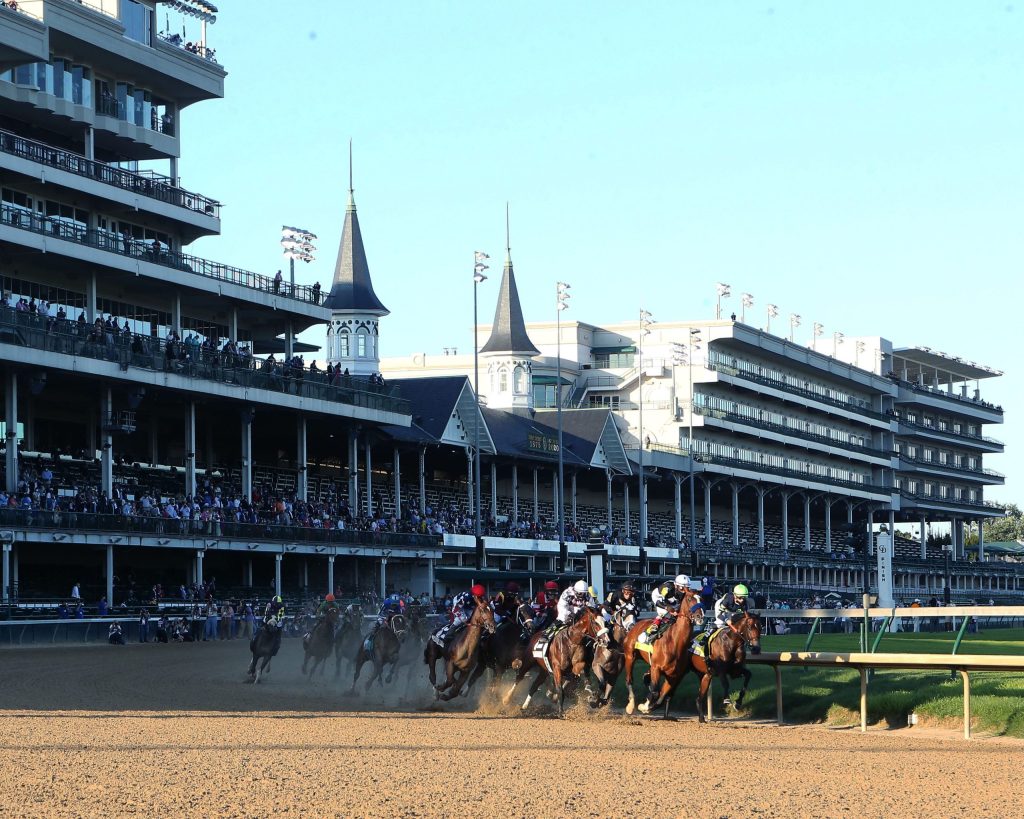
As much as the Kentucky Derby (G1) has stayed the same and replicated decades worth of traditions, perhaps the biggest change overall may be the actual field size, or actual numbers of runners who will be trying to make the gate on the first Saturday in May.
The Kentucky Derby field has been limited to 20 starters since 1975, the year after 23 horses contested the 100th anniversary of the Derby. Until 2022, at least 20 horses were entered in the race every year since 2004, and 22 of the last 24 years.
Overall, there has been a field of 20 horses on 23 occasions, the first happening in 1923 when 21 horses went to the post, and there have been at least 16 starters in 26 of the last 27 years. There were 15 runners in 2020.
Largest Field: 23 in 1974 (100th running)
Smallest Field: 3 in 1892 and 1905
Total Starters: 2.034 from 1875 through 2025
Avg. Field Size: 13.5 from 1875 through 2025
Fields of 20 or More: 23
Fields of 15 or More: 72
Fields of 14 or Less: 79
Churchill Downs reintroduced the also-eligible rule in 2012. Up to 24 horses may be entered in the race, including four horses that can remain eligible to compete beyond the official time of entry. One or more of the “also-eligible” horses could be allowed to run in their respective race if members of the original field scratch from the race prior to the official “scratch time” of 9 a.m. ET on Friday (Kentucky Oaks Day), which is the official opening of advance wagering on the Derby. In 2023, Rich Strike drew in from the also-eligible list and won at 80-1.
Horses with the highest point totals in the “Road to the Kentucky Derby” races “draw -in” to the field first. The same rules apply for the Kentucky Oaks, which has a maximum field size of 14. An eight-horse also-eligible list was instituted in 1983 and 1984, but advance wagering on the Kentucky Derby was negated because of refunds after late scratches.
Although the 20-horse limit for the Kentucky Derby has been in existence since 1975, 21 horses were allowed to contest the 1981 Derby due to a “legal issue.”
That year, entries were determined by earnings. Flying Nashua was 21st on the list and initially was excluded. Flying Nashua’s owners and the owners of another horse, Mythical Ruler, filed a lawsuit in Jefferson Circuit Court, arguing that Churchill Downs had misinterpreted its own qualification rules. The court sided with them, forcing the track to allow the extra horse(s). One scratch (the filly Wayward Lass) still left 21 starters after the legal ruling.
The writing team at US Racing is comprised of both full-time and part-time contributors with expertise in various aspects of the Sport of Kings.