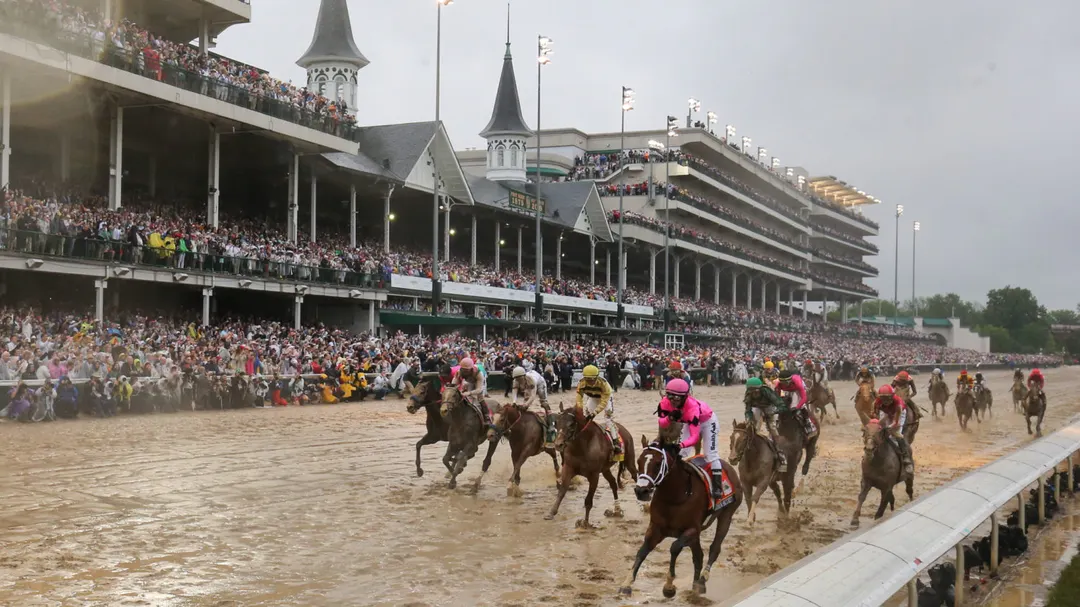
The 152nd Kentucky Derby goes to post Saturday, May 2, 2026, at Churchill Downs. Post time is 6:57 PM ET. Five million dollars in total purse money, $3.1 million to the winner, a full field of three-year-olds, and the biggest single-race betting handle in American racing. If you have been around this game long enough, you already know what Derby Day means. There is nothing else like it on the calendar.
For California bettors, this is not a spectator event. It is a wagering opportunity, and the official Kentucky Derby odds deserve serious attention before you put a dollar in the pools. This guide covers how to read the field, use the morning line, structure your tickets, and access full pari-mutuel wagering from anywhere in California through US Racing.

Let us be clear about something before we get into pace scenarios and ticket structures: California is not a casual racing state. Santa Anita Park in Arcadia has been a cornerstone of the American thoroughbred game for nearly 90 years. Del Mar, running summer meets on the Pacific coast since 1937, has produced major Derby contenders year after year. Golden Gate Fields rounds out a state that has watched this sport develop across multiple generations of horseplayers, trainers, and owners.
The Santa Anita Derby is a Grade 1 at a mile and an eighth. It is not a regional qualifier. It is one of the premier three-year-old tests in the country, run against the best horses on the West Coast, and it carries serious Road to the Kentucky Derby points. Horses who earn their way through the California prep sequence at Santa Anita and Del Mar have been asked real questions against graded stakes fields. That matters when you are sorting the top half of your exotic tickets from the bottom half.
The Kentucky Derby prep races out of California have historically produced genuine Churchill Downs threats, not horses padding their resumes in soft company. When a horse survives that West Coast path and shows up on the Kentucky Derby contenders list with a figure earned at Santa Anita against a quality field, you are looking at a horse who has been tested.
California bettors have access to full pari-mutuel wagering on the Derby and every race on the Churchill Downs card through US Racing. Los Angeles, San Francisco, San Diego, Sacramento, anywhere in the state, you are in the pools from your phone or desktop. No track trip required.
The morning line is posted by the Churchill Downs oddsmaker. It is a starting point, not a prediction. By the time the gates open at 6:57 PM ET, the tote board will look considerably different. That gap between the morning line and the actual odds is where the real handicapping work begins.
When the official Kentucky Derby odds go live Saturday morning, you are looking for two things: overlays and underlays. An overlay is a horse trading at higher odds than his form actually warrants. An underlay is a horse the public has bet down below his real probability of winning. The chalk in a Derby field is almost always an underlay. Twenty horses, public money concentrating on two or three names, and the pools take care of the rest.
| 2026 Kentucky Derby Odds and Post Positions | ||
| PP | Horse / Jockey / Trainer | Fractional |
|---|---|---|
| 1 | RenegadeI. Ortiz Jr. · T. Pletcher | 4/1 |
| 2 | AlbusM. Franco · R. Mott | 30/1 |
| 3 | IntrepidoH. Berrios · J. Mullins | 50/1 |
| 4 | Litmus TestM. García · B. Baffert | 30/1 |
| 6 | CommandmentL. Saez · B. Cox | 6/1 |
| 7 | Danon BourbonA. Nishimura · M. Ikezoe | 20/1 |
| 8 | So HappyM. Smith · M. Glatt | 15/1 |
| 10 | Wonder DeanR. Sakai · D. Takayanagi | 30/1 |
| 11 | IncrediboltJ. Torres · R. Mott | 20/1 |
| 12 | Chief WallabeeJ. Alvarado · B. Mott | 8/1 |
| 14 | PotenteJ. Hernández · B. Baffert | 20/1 |
| 15 | Emerging MarketF. Prat · C. Brown | 15/1 |
| 16 | PavlovianE. Maldonado · D. O'Neill | 30/1 |
| 17 | Six SpeedB. Hernández Jr. · B. Seemar | 50/1 |
| 18 | Further AdoJ. Velazquez · B. Cox | 6/1 |
| 19 | Golden TempoJ. Ortiz · C. DeVaux | 30/1 |
| 21 | Great WhiteA. Achard · J. Ennis | 50/1 |
| 22 | OcelliJ. Ramos · W. Beckman | 50/1 |
| 23 | RobustaE. Jaramillo · D. F. O'Neill | 50/1 |
Last Updated on 05/02/2026
Watch the odds movement in the final thirty minutes before post. Sharp money moves late. If a horse drops from 15-1 to 8-1 in the last two tote updates, someone is making a strong opinion known with real dollars. That is information. Use it. It does not mean you blindly follow the stream, but you do not ignore it either.
Track the Kentucky Derby odds movement throughout Derby Day at US Racing, where you can monitor connections, late scratches, and updated form as the field firms up.
Nineteen horses are going a mile and a quarter. The pace scenario in this race is not a secondary consideration. It is primary. Here is how to think about it.
If the field has multiple speed horses drawn inside, the early fractions will be honest or faster, which historically sets up the closers and stalkers coming from mid-pack. If the pace is soft, a front-runner with a high figure and clean air can steal it on the lead. The Derby has been won from every point in the pace scenario, but horses who have to spend energy fighting for position in a 20-horse first turn scramble burn reserves they cannot recover.
Post position matters in this race, but it is not the absolute it sometimes gets treated as. What matters more is how a horse handles traffic, where he sits through the first turn, and whether his running style aligns with the pace that sets up on the day. A closer needs a pace to run at. A stalker needs to be within striking range at the half-mile pole. A front-runner needs to clear the first turn without a war on his outside.
When you pull up speed figures on the Kentucky Derby entries, look at where those numbers were earned and under what pace conditions. A big figure earned on the front end at a synthetic track against a soft pace is a different animal than the same number earned closing into a genuine hot pace at Santa Anita or Keeneland. Context matters as much as the number itself.
The Derby is a Grade 1 at a mile and a quarter. No horse in this field has run that far before. Class is the bridge between what we know and what we are about to find out.
Horses who have run legitimate figures in Grade 1 prep races against quality fields are telling you something. Horses who look brilliant in allowance company or off a soft Grade 3 win are showing you considerably less. Trip handicapping the preps matters here. Was that visually impressive performance in the Santa Anita Derby earned against a field that set up perfectly for the winner, or was it a genuine come-from-behind effort into pace pressure? Those are different conversations, and they lead to different conclusions on your ticket.
Trainer intent is also part of the class reading. Some barns point horses specifically at Churchill Downs every spring. Todd Pletcher, Brad Cox, Bob Baffert when eligible, Steve Asmussen, Chad Brown. These operations understand how to cycle a horse into peak form for a mile and a quarter. When one of those trainers has a horse working correctly in the two weeks before the Derby, moving through his drills with purpose and showing up fresh on the day, that matters in your handicapping. When a smaller operation earns a spot on points and the figures are thin, you want more evidence before you invest significantly.
Jockey assignments tell you something, too. Irad Ortiz Jr., Flavien Prat, John Velázquez, Joel Rosario. When a top-tier rider takes a live mount in the Derby, it is rarely a coincidence. When a barn switches riders in the final week before the race, that is also a signal worth reading carefully.
The Kentucky Derby betting guide at US Racing covers the full menu of wagers available on the race. Here is how a seasoned player approaches the card.
Win betting on a horse you genuinely believe in at a fair price is never wrong. If you have done the work and you like a horse at 12-1 or better, a straight win bet is a clean, honest way to play it. Do not apologize for the basics.
The exotics are where Derby Day gets interesting. The exacta, trifecta, and superfecta pools are enormous, and that size creates opportunity if you are structured correctly. The mistake most bettors make is using too few horses in the wrong positions. In a 20-horse field, keying one horse on top of a two-horse second is not a ticket. It is a prayer.
Build trifecta and superfecta tickets around your opinion on the pace scenario. If you believe the pace will be honest and the race sets up for closers, your top horses should reflect that, with a stalker or two mixed in as insurance. Use the chalk underneath in the third and fourth spots if the price is right on top.
For Pick 4 and Pick 5 players, Kentucky Derby betting through US Racing gives you access to the full Churchill Downs card. The races leading into the Derby are legitimate handicapping puzzles in their own right, and the sequential pools build throughout the afternoon. Know which races you are confident in and spread in the ones where the form is murky. Do not single-horse you do not fully trust just to keep the ticket cost manageable.
Check the Kentucky Derby props page at US Racing for additional wagering options available on race day.

Understanding how each horse qualified helps you assess who genuinely belongs. Review the Kentucky Derby prep races with an eye toward the quality of each effort, not just the result. A horse who ran second in the Blue Grass Stakes at Keeneland against a legitimate field may have more to offer than a horse who won a points race in a short field with a soft pace.
The Kentucky Derby winners page at US Racing gives you the historical record. Pattern recognition matters in this sport. Certain trainer-jockey combinations, certain prep race sequences, and certain pace scenarios have produced Derby winners with meaningful frequency. That is not superstition. It is data.
After the race, the track final positions and payouts at the Kentucky Derby results page. If you are alive in a Pick 4 or chasing a superfecta, you will want real-time information as the order of finish is confirmed.
If the Derby winner shows up as a legitimate Triple Crown contender, the Preakness and Belmont are already worth putting on your calendar. US Racing offers a Triple Crown bonus for bettors following the series, and the Breeders' Cup free bet opportunity runs for players engaged with the full stakes calendar. Worth knowing before Derby Day is over.
The Kentucky Derby is the most bet horse race in the country, and it is also one of the most difficult to handicap correctly. The distance is new for every horse in the field. The field size creates chaos in the first turn. The public money compresses the chalk and inflates the price of horses who deserve it. That is the challenge, and it is also the opportunity.
Do the work on the pace scenario. Respect the class evidence. Watch the official Kentucky Derby odds board for late movement that tells you where the informed money is landing. Build tickets that give you coverage without burying yourself in costs that no realistic outcome can justify.
California bettors have been watching good horses come out of Santa Anita and Del Mar for decades. You know what a genuine stakes horse looks like. Trust that knowledge on Saturday, structure your tickets with discipline, and get in the pools through US Racing before the gates open at Churchill Downs.
Good luck at the windows.

The writing team at US Racing is comprised of both full-time and part-time contributors with expertise in various aspects of the Sport of Kings.