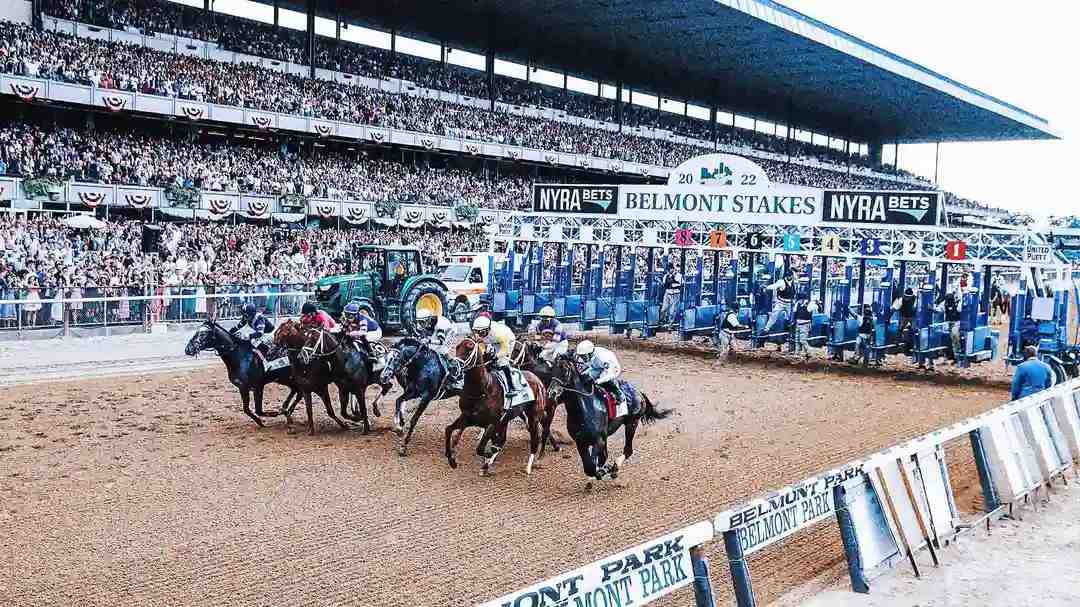
Notes and Nuggets from the Belmont Stakes Record Book
Secretariat
Secretariat holds the record for the fastest Belmont when he completed his 1973 Triple Crown sweep with a time of 2:24 for the 1 ½ miles. The son of Bold Ruler also holds the fastest splits for a half-mile, three-quarters of a mile, 1 mile, and 1 ¼ miles.
Secretariat, Part 2
With all those record times, Secretariat also holds the record margin of victory with his 31-length romp over Twice a Prince. Count Fleet, the 1943 Triple Crown winner, has the second largest margin of victory – 25 lengths. Man o’War is next with a 20-length win in 1920 when the race was run at 1 3/8 miles.
Jockeys
Hall of Famers Jim McLaughlin and Eddie Arcaro each rode six Belmont Stakes winners. Among Arcaro’s wins was aboard 1948 Triple Crown winner Citation.
Trainers
James G. Rowe, who trained 1948 Triple Crown winner Citation, leads all conditioners with eight Belmont winners between 1893 and 1913. He also rode two winners in 1872 and 1873. Hall of Famer Woody Stephens tops the list with five wins in consecutive years from 1982-86. Hall of Famer Todd Pletcher, who is tied with several trainers with four wins, could join Stephens on Saturday if either of his Belmont Stakes entries – Renegade or Powershift – comes out on top.
Owners
Owners Belair Stud and James R. Keene each sent out six Belmont Stakes winners.
Fillies
Rags to Riches, trained by Todd Pletcher, became the third filly to win the Belmont in 2007 – and first in 103 years. Tanya won in 1905 and Ruthless in 1867. No fillies in Saturday’s race; the last to run was Nest, who ran second to stablemate Mo Donegal in 2022.
Female Jockey
Hall of Famer Julie Krone is the only female jockey to win the Belmont, when she rode Colonial Affair to victory in 1993
Sarava in 2002 is the longest-priced winner when he paid $142.50.
Purse
The Belmont Stakes is worth $2 million. The purse for the first running was $1,500-added, with a total purse of $2,500, the $1,850 winner’s share going to the connections of the filly Ruthless. For many years, the great A.P. Indy held the title as the winner of the richest edition of the Belmont when he earned $458,880 of the $1,764,800 purse. The lion’s share ($1,091,776) went to Pine Bluff, which claimed the Chrysler Corporation Bonus, which went to the owner of the horse with the highest combined Triple Crown finishes as part of the Triple Crown Bonus Program.
Fields
There has never been a “walkover” or a race with a single participant in the Belmont Stakes. There have been five two-horse fields (1887, 1888, 1892, 1910, 1920). Unlike the Kentucky Derby, where it’s a challenge to limit participation to just 20, the Belmont rarely has a full field. The largest was 15 in 1983 when Caveat defeated Slew o’ Gold; the second-largest fields were 14 in 1875 when Calvin beat Derby winner Aristides, 1996 when Editor’s Note won, and in 2013 when Palace Malice emerged victorious.
Post Positions
The inside post has been the most successful overall, having produced 24 winners. Post 3 has produced 16 winners, 5 has 15, and the 7 slot has 13. Post position 12 and post 10 have produced just a single winner. Only one horse has won from outside post position 12 (the 13).
The forecast for Saturday in New York calls for afternoon thunder showers and a solid chance for rain and an off track by post time for the Belmont Stakes (7:04 p.m. EDT). Of the 157 previous runnings, 38 (23.71%) have been run on a track labeled “off,” the most recent being 2011, when Ruler On Ice won on a track with a “sloppy/sealed” surface. Last year, Sovereignty won over a “good” track.
Geldings: Ruler On Ice became the second gelding to win the Belmont when he won in 2011. In 1985, Creme Fraiche became the first to do so. Geldings were allowed to compete in the race from its inaugural running in 1867 to 1918 and even received a three-pound weight allowance. After 1918, geldings were banned from running in the race until 1957. New York-bred Funny Cide won the Kentucky Derby and Preakness Stakes but did not win the Triple Crown when he finished third behind Empire Maker in 2003.
Post Parade
The first post-parade in North America took place at the fourth running of the Belmont in 1871 and is now a staple at racetracks around the country.
Betting
Since the introduction of pari-mutuel wagering in New York in 1940, there has been no show wagering on the Belmont six times, most recently in 1978 when Triple Crown winner Affirmed met Alydar after finishing first and second in the first two legs. There was also no show wagering in 1973 when Secretariat won. Show betting was also eliminated in 1957 when Gallant Man and Bold Ruler faced off, the former romping to an eight-length win under jockey Bill Shoemaker. The 1953 Belmont won by Native Dancer was also without show wagering, and the 1943 Belmont won by Count Fleet, which also crowned him a Triple Crown champion, didn’t offer place or show wagering. And when Whirlaway completed his sweep of the Triple Crown in the 1941 Belmont, there was also no show betting.
US Racing is not a racebook or ADW, and does not accept or place wagers of any type. This website does not endorse or encourage illegal gambling. All information provided by this website is for entertainment purposes only. This website assumes no responsibility for the actions by and makes no representation or endorsement of any activities offered by any reviewed racebook or ADW. Please confirm the wagering regulations in your jurisdiction as they vary from state to state, province to province and country to country. Any use of this information in violation of federal, state, provincial or local laws is strictly prohibited.