

Published: Friday, May 2, 2026
The 152nd running of the Kentucky Derby goes to the gate Saturday, May 2, at 6:57 PM ET, and if you have been around this game long enough, you already know what this week feels like. The tote is moving, the connections are managing the press, and the overnight lines are getting stress-tested by sharp money that does not wait for Saturday morning. Every piece of information you can collect before that gate opens matters, and the clock is running.
NBC carries live coverage from noon Eastern, with Peacock handling the stream for anyone working from home or a mobile device. But if you are serious about Kentucky Derby betting, you are not watching this race. You are handicapping it, from the first undercard post to the final tote snapshot two minutes before the field loads.
Here is where you start.

Derby Day Schedule: Gates, Post Time, and What Actually Matters
Churchill Downs opens at 9:00 AM ET. The first post on the undercard follows shortly after, and the field does not go to the gate for the Derby itself until approximately 6:57 PM ET. That is a long afternoon, and serious bettors treat every race on that card as working intelligence, not background noise.
NBC picks up at noon Eastern. Peacock covers the stream. If you are building a ticket at home, you have wall-to-wall content from jump, and you should be using it. The undercard is not filler. It is your last live read on how this surface is playing before you commit real money to the big one.
- Churchill Downs gates open: 9:00 AM ET
- NBC coverage begins: 12:00 PM ET
- Peacock stream: Live alongside NBC
- Kentucky Derby post time: 6:57 PM ET
Live Derby Day Updates: May 2, 2026
9:00 AM ET: Track Condition and First Look
Churchill Downs gates open. Track condition reported as fast. Forecast holds at 72 degrees with no rain expected through post time. No weather concern at this hour, but keep an eye on the late afternoon radar. Louisville in May has its own ideas.
11:30 AM ET: Early Win Pool Movement
Win pool action shows the morning line favorite drifting from 5/2 out to 7/2 as live money enters the pool. More telling: the stalkers in the 8-1 to 12-1 range are getting hammered. That kind of early action on mid-price horses is worth noting. It does not always mean sharp money, but it means somebody likes the pace setup for horses that can sit and pounce.
6:40 PM ET: Post Parade and Warmup Read
Field is on the track. Watch the warmup behavior closely, particularly on entries drawn wide outside post 14. A horse that ships in from Japan or does not school well in large fields will sometimes tell you everything you need to know during the post parade that the past performances cannot.
6:55 PM ET: Final Tote Board
Two minutes to post. The late money has done its work. Pull the final Kentucky Derby odds before you make any last-minute adjustments to your ticket. What the board shows at this moment is the market's final statement.
Weather at Churchill Downs: Why the Track Condition Report Is Not Optional
The 2026 forecast currently points to a mild spring afternoon, 72 degrees, fast track on paper, no precipitation expected. For most bettors, that is a green light. For experienced handicappers, that is a starting point, not a conclusion.
Louisville in early May can flip on you fast. A Midwestern thunderstorm rolling through late afternoon has reshuffled more Derby tickets than any other variable in the history of this race. When the surface goes off, the deck gets cut and dealt fresh. Horses with mudder pedigrees or front-running styles on a sealed track move up sharply. Some of the chalk with gaudy speed figures on a dry surface become very beatable. The connections who have been playing it cool all week start getting very interested in the tote.
Pull the final Churchill Downs track condition report before you lock in any position. One late shower can turn your well-structured ticket into a lesson in overconfidence.
Reading the Undercard: Derby Day Races as Handicapping Intelligence
Derby weekend is a two-day operation, and treating it as anything less leaves money on the table. It started Friday with the Kentucky Oaks, the premier race for three-year-old fillies, which was your first live read on how this surface is playing. If you watched it closely, you already have a picture of where the winners are coming from.
On Saturday, the undercard includes Grade 1 stakes worth your full attention: the Old Forester Bourbon Turf Classic and the Churchill Downs Stakes. These are not just separate betting opportunities. They are data. Watch the stretch calls. Watch where the winners are sitting at the quarter pole. If wire-to-wire speed is holding all afternoon, you need to reassess every closer on your Kentucky Derby entries sheet. A rail bias or a speed-favoring surface makes your pace analysis either very right or very wrong, and you will not know which until horses are actually running over it.
What History Tells You About Kentucky Derby Betting
Secretariat set the standard in 1973 at 1:59.40, a number that has never been touched and likely never will be. More recent winners like Mystik Dan and Mage remind us that this race keeps producing new icons while the profiles of those winners continue to shift.
The morning-line chalk does not dominate this race the way it once did. The last decade has tilted clearly toward tactical speed: horses that can sit two or three lengths off the pace through the first six furlongs, let the speed duel sort itself out on the far turn, and still have enough left to run through tired horses in the stretch. That is not a stylistic preference. It is a structural reality. With fields of 18 to 20 horses and a pace scenario that almost always develops into a genuine speed duel up front, the stalker position has posted the highest win percentage of any running style over the modern era of this race.
That historical context is the first filter you apply when looking at Kentucky Derby contenders. Before you build a ticket, know where each horse is likely to be at the first call and whether the pace setup is going to set them up or bury them.
2026 Kentucky Derby Odds and Post Positions: Full Field Breakdown
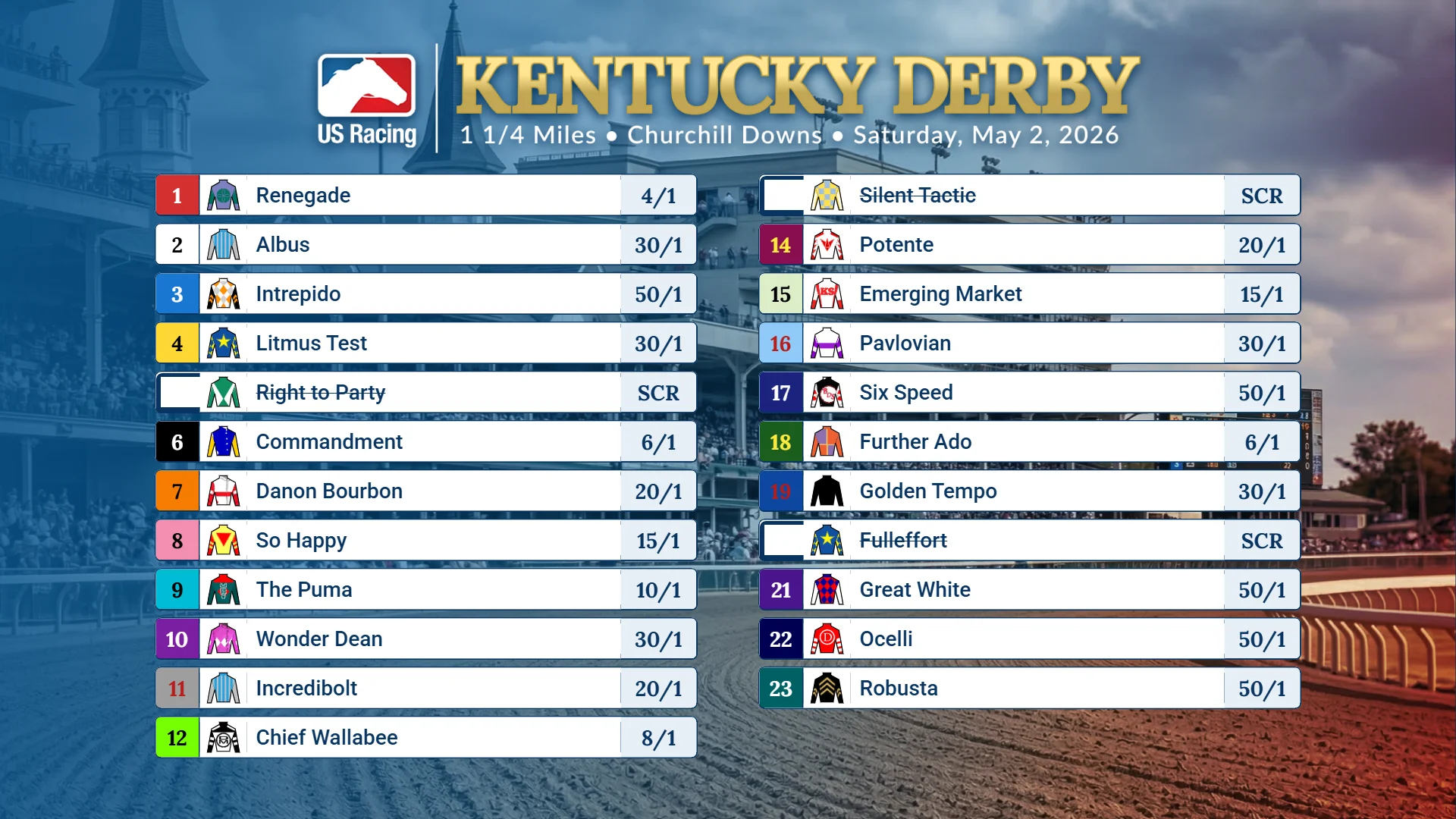
Below is the full field with post positions, jockey and trainer assignments, and current Kentucky Derby odds. Use this alongside your speed figures and pace projections. Post position matters in a 20-horse field, particularly early in the first turn. A horse drawn wide that needs to find cover early is in a different race than the same horse drawn inside.
| 2026 Kentucky Derby Odds and Post Positions | ||
| PP | Horse / Jockey / Trainer | Fractional |
|---|---|---|
| 1 | RenegadeI. Ortiz Jr. · T. Pletcher | 4/1 |
| 2 | AlbusM. Franco · R. Mott | 30/1 |
| 3 | IntrepidoH. Berrios · J. Mullins | 50/1 |
| 4 | Litmus TestM. García · B. Baffert | 30/1 |
| 6 | CommandmentL. Saez · B. Cox | 6/1 |
| 7 | Danon BourbonA. Nishimura · M. Ikezoe | 20/1 |
| 8 | So HappyM. Smith · M. Glatt | 15/1 |
| 10 | Wonder DeanR. Sakai · D. Takayanagi | 30/1 |
| 11 | IncrediboltJ. Torres · R. Mott | 20/1 |
| 12 | Chief WallabeeJ. Alvarado · B. Mott | 8/1 |
| 14 | PotenteJ. Hernández · B. Baffert | 20/1 |
| 15 | Emerging MarketF. Prat · C. Brown | 15/1 |
| 16 | PavlovianE. Maldonado · D. O'Neill | 30/1 |
| 17 | Six SpeedB. Hernández Jr. · B. Seemar | 50/1 |
| 18 | Further AdoJ. Velazquez · B. Cox | 6/1 |
| 19 | Golden TempoJ. Ortiz · C. DeVaux | 30/1 |
| 21 | Great WhiteA. Achard · J. Ennis | 50/1 |
| 22 | OcelliJ. Ramos · W. Beckman | 50/1 |
| 23 | RobustaE. Jaramillo · D. F. O'Neill | 50/1 |
Last Updated on 05/02/2026
A few things jump out of this field immediately when you cross-reference post position against running style.
Renegade from the rail with Irad Ortiz Jr. up and Todd Pletcher training is about as sharp a combination as you will find in this race. Pletcher knows Churchill Downs, and Ortiz knows how to manage a horse out of the one hole without burning him early. At 4/1 on the morning line, he is the chalk, and there is legitimate reason for it. The question is whether the morning line holds or whether the win pool pushes him down to 3/1 or below by post time, at which point the value conversation changes.
Commandment at 6/1 with Luis Saez and Brad Cox is worth a serious look for anyone building a multi-race ticket. Cox has become one of the most dangerous trainers in the country at bringing three-year-olds to a peak in the spring, and Saez is comfortable in large fields. The post position at 6 sets up well for a horse that wants to sit just off the pace and make one run. If you are looking for a legitimate stalker in the mid-price range, this is where the conversation starts.
The Puma at 10/1 with Javier Castellano is another horse worth flagging. Castellano does not take mounts in this race unless he believes in the horse, and a double-digit price on a Castellano ride at Churchill Downs deserves a closer look at the Beyer and Brisnet figures before you cross him off. If the speed figures support it and the Kentucky Derby prep races show a progression, 10/1 on a horse with a sharp jockey and a viable pace setup is exactly the kind of overlay you are looking for.
The Japanese shippers, Danon Bourbon and Wonder Dean, are at long prices for a reason. Trip handicapping across international preps is genuinely difficult, and the Churchill Downs surface plays very differently than anything they have seen. That said, Japanese-trained horses have improved in this race in recent cycles, and if either shows clean behavior in the post parade and gets a ground-saving trip early, the 20/1 and 30/1 prices make them worth a small piece of the exotics.
Speed Figures, Pace Scenario, and the Real Kentucky Derby Betting Framework
The Beyer and Brisnet figures for this field tell part of the story. The other part is pace. A horse that ran a 98 Beyer in a soft pace scenario at Keeneland is not the same animal as a horse that earned a 96 under pressure at Santa Anita against a real pace. Context matters, and in a 20-horse field at a mile and a quarter, the pace scenario in the first six furlongs is the race within the race.
Projecting this field forward, you have enough early speed sources to guarantee genuine pressure through the opening fractions. That sets up the stalkers. That is not a novel observation for experienced handicappers, but the execution is in identifying which stalker has the class to handle the stretch run when the horses who burned themselves up front start backing up in front of them. Class drops and form cycles apply here as much as they do in any other race on the card.
When building your Kentucky Derby betting guide approach, the basic framework looks like this:
- Identify the early speed sources and project the pace scenario honestly. Do not assume pace pressure if only one horse wants the lead.
- Match speed figures to the surface and trip context in which they were earned.
- Evaluate form cycles. Is each contender improving, peaking, or declining off their last two or three starts? A horse peaking at the Derby is very different from one who peaked three weeks ago.
- Assign running style to post position. A confirmed closer drawn in the two hole in a large field is in a problematic spot. A stalker drawn in the six to ten range is in a comfortable spot.
- Check the Kentucky Derby trainer betting and Kentucky Derby jockey betting angles. Trainer intent at this time of year, whether a horse is pointed here as the primary target or came through as a secondary option, affects how sharp the horse actually is today.
How to Bet on the Kentucky Derby Online: Wagering Structure
If you are betting on the Kentucky Derby online, the wagering menu at this race goes deep. Win, place, and show pools are the foundation, but the exotic menu is where serious money gets structured.
The exacta and trifecta pools at the Derby are among the largest in North American racing. The superfecta, when the right long-priced horse finds the board, can return figures that people talk about for years. If you are building a multi-race sequence, the late Pick 4 and Pick 5 that sequence through the Derby are structured tickets worth your time. A strong single in the Derby anchors the ticket, but your single needs to be something you genuinely believe in, not the chalk by default.
A few practical notes on ticket construction:
- In a 20-horse field, using a single win candidate in the trifecta and superfecta underneath multiple horses is a reasonable structure. The favorites have to beat a lot of horses to win this race.
- The exacta wheel is effective here when you have one strong top selection and want coverage underneath without overcomplicating the ticket cost.
- For the superfecta, boxing four horses at a ten-cent minimum is an accessible structure. Know your cost before you commit.
- If you are in a multi-race sequence, do not load your ticket so heavily on the Derby leg that you burn your bankroll before the sequence completes. Balance the investment across the legs.
You can review current pricing, pool sizes, and live Kentucky Derby odds at US Racing, and get your wagers in before the pools close. US Racing also has rebates up to 10 percent, which on a race of this size and pool depth makes a real difference over the full card.
Final Thoughts Before the Gate Opens
The 152nd Kentucky Derby has a field with legitimate pace questions, a couple of international shippers adding uncertainty, and a morning-line favorite at 4/1 who is going to draw heavy public money. That combination is exactly what creates overlay opportunities in the mid-price range for bettors who have done the work.
Watch the undercard. Pull the final track condition. Check the late tote movement. And before you finalize anything, revisit the Kentucky Derby betting guide at US Racing for updated analysis through post time.
The gate opens once. Make sure your ticket reflects what you actually believe, not what the crowd is telling you to think.
Ready to bet on Kentucky Derby online? US Racing gives you $1,000 Cash plus up to 10% Rebates. Get your account set up and your tickets in before the pools close.